Palm Sunday: Beginning the Journey to the Cross
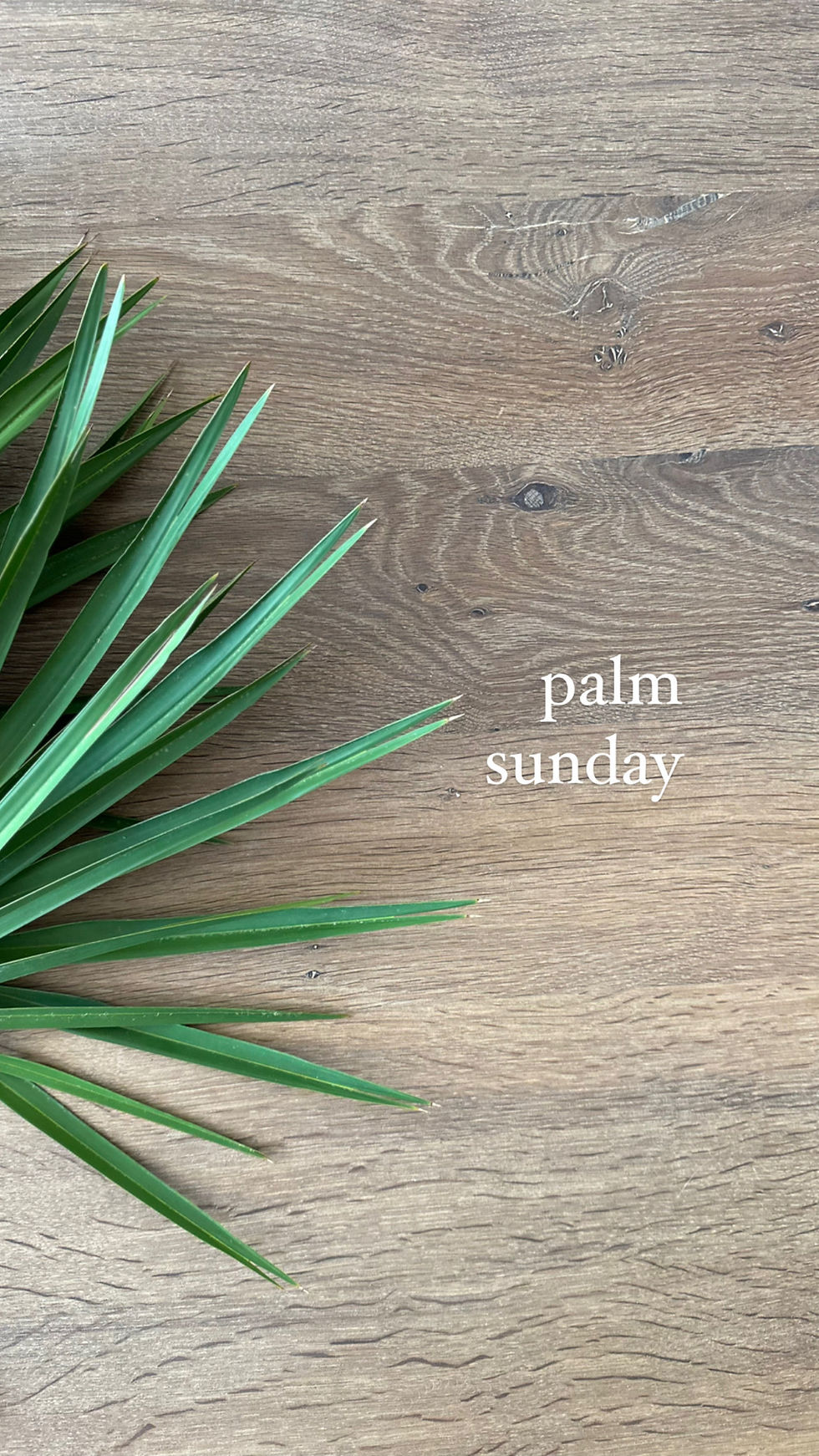
Palm Sunday marks the beginning of Holy Week, the holiest week of the Church year. During this week, we walk with Jesus through His final days before His crucifixion, following Him step by step as the story of our salvation unfolds.
The tone of the week begins with joy as we remember His triumphal entry into Jerusalem. Like the crowds in the Gospels, we take up palm branches and cry out, “Hosanna,” proclaiming Jesus as the King of Kings and remembering His ultimate victory over death. We also pray that we, who bear these palms, may “ever hail Him as our King and follow Him in the way that leads to eternal life” (Book of Common Prayer).
And yet, this day holds both joy and sorrow.
The celebration of His arrival already points toward the path to the cross. We are reminded of our own human frailty, for the same voices that shouted “Hosanna” would soon cry out for His crucifixion. At the same time, we see more clearly the humility of Christ. He does not enter in power or force, but in peace and gentleness, inviting us to consider the true nature of His kingdom.
The Scripture Story of Palm Sunday
All four Gospels recount Jesus’s triumphal entry into Jerusalem. The Gospel of Luke tells us that Jesus “set His face toward Jerusalem” (Luke 9:51), fully aware that this journey would lead to His death. Along the way, He continued teaching, healing, and proclaiming the coming of God’s kingdom.
As Jesus and His disciples approached Jerusalem, arriving at Bethphage on the Mount of Olives, He sent two disciples ahead with a clear instruction: to find a donkey and her colt, untie them, and bring them to Him. The disciples obeyed, placing their cloaks on the animals as makeshift saddles.
As he entered the city, a great crowd gathered. They spread their cloaks and palm branches along the road, welcoming Him with shouts of praise:
“Hosanna to the Son of David! Blessed is He who comes in the name of the Lord! Hosanna in the highest heaven!”
Not everyone received Him with joy. The Pharisees were troubled by the crowd’s response and urged Jesus to rebuke His disciples. But He answered that if they were silent, the very stones would cry out (Luke 19:39–40).
As Jesus drew near and looked upon Jerusalem, He wept. His sorrow was for those who did not recognize the moment before them, for the peace that could have been theirs. He foresaw the suffering that would come, knowing that the city would one day be besieged and brought to ruin.
The Symbols of Palm Sunday
Palms
In the Roman world, palm branches were a symbol of triumph and victory. They were used to honor those of great importance, laid along the road, and waved in celebration.
In the life of the early Church, palms also came to represent the victory of martyrs, those who remained faithful even unto death. They appear again in Revelation 7:9, where a great multitude from every nation stands before the throne, clothed in white and holding palm branches in their hands.
Riding on a Donkey
Jesus’s entry into Jerusalem on a donkey fulfills the prophecy of Zechariah 9:9:
Rejoice greatly, Daughter Zion!Shout, Daughter Jerusalem!See, your king comes to you,righteous and victorious,lowly and riding on a donkey,on a colt, the foal of a donkey.
The choice of a donkey is significant. Kings rode horses in times of war, but donkeys in times of peace. In this, Jesus reveals the nature of His kingdom, not one of earthly conquest, but of peace, humility, and self-giving love.
The Palm Sunday Service
Palm Sunday typically begins with the Liturgy of the Palms. Many congregations gather outside the church, where palm branches are blessed and distributed. The Gospel account of the triumphal entry is read, and the people process into the church, carrying their palms and singing hymns such as All Glory, Laud, and Honor, echoing the cries of “Hosanna.”
A reading of the Passion of Christ also plays a central role in the service. Often read dramatically, with different voices representing the various figures in the narrative, it invites us to enter more deeply into the story of Christ’s suffering and death, setting the tone for the days that follow.
The vestments for the day are a deep red, recalling the blood of Christ and pointing ahead to the sacrifice He is about to make.
Palm Sunday Traditions Around the World
Palm Sunday is observed in many beautiful and varied ways across the world:
In India, the congregation repeats “Hosanna! Blessed is He who comes in the name of the Lord God” three times, followed by a communal shout of “Hosanna,” and marigolds are scattered throughout the sanctuary.
In northern regions where palms are not available, branches such as pussy willows are used. In Latvia, the day is known as “Pussy Willow Sunday,” and the branches are sometimes used in playful traditions to “wake” children.
In Hoegaarden, Belgium, a large procession takes place, with men dressed as the apostles carrying a wooden statue of Christ through the town, while children offer palms in exchange for coins.
In the Coptic and Ethiopian Orthodox Churches, where the day is often called “Hosanna,” palm leaves are woven into crosses and other forms before being distributed.
In the Philippines, a statue of Christ riding a donkey is processed through the streets, with people lining the route and waving intricately woven palms.
In parts of England, Pax Cakes (“peace cakes”) are distributed. This tradition dates back centuries and was intended to encourage reconciliation among parishioners before Easter Communion.
Ways to Observe Palm Sunday
Read Matthew 21:1–11
Take time to read the account of Jesus’s entry into Jerusalem, either on your own or with your family.
Attend a Palm Sunday service
Holy Week is one of the most important times in the Christian year. Traditionally, every effort is made to attend the services of this week.
Keep your palms
Because the palms are blessed, they should not be thrown away. Many people bring them home and place them near a cross or doorway, or press them into a Bible. They are often returned to the church the following year to be burned for Ash Wednesday.
Recommit to your Lenten discipline
As Holy Week begins, consider returning with intention to the practices you may have set aside during Lent.
Make a Palm Sunday wreath
Create a simple wreath using palm branches and a red ribbon. If palms are not available, any greenery can be used.
Make a Palm Sunday mobile
A simple and meaningful way to decorate your home, especially with children, using materials you already have.
Make Pax Cakes
Try baking traditional round shortbreads stamped with Christian symbols such as the lamb or Chi Rho. Recipe at the end of the article.
Holy Week begins here.
We welcome Christ with joy, even as we know where the road leads. And as we take up our palms and join the crowd, we are invited not only to remember, but to follow, to walk with Him through the days ahead.
the recipe -

Pax Cakes
3/4 pound unsalted butter, at room temperature
1 cup sugar
1 teaspoon vanilla
3 1/2 cups all-purpose flour
1/4 teaspoon salt
1 cup powdered sugar
1 to 2 Tablespoons milk
Preheat the oven to 350 degrees F.
In the bowl of an electric mixer fitted with a paddle attachment, mix together the butter and 1 cup of sugar. Add the vanilla salt. Add flour and mix on low speed until the dough starts to come together. Dump onto a surface dusted with flour and shape into a flat disk. Wrap in plastic and chill for 30 minutes.
Roll the dough 1/2-inch thick and cut with a round cookie cutter or a clean jelly jar. Place the cookies on an ungreased baking sheet. Bake for 20 to 25 minutes, until the edges begin to brown. Allow to cool to room temperature.
When the cookies are cool, place them on a baking sheet lined with parchment paper. Blen the powdered sugar with enough milk to form a thin icing. Put icing in a sandwich baggie and clip a corner of the baggie to use to pipe the icing. Draw the Chi Rho insignia on each cookie.


Comments