Prayer and Scripture: The Foundation of the Sacred Home
- 23 hours ago
- 4 min read
Welcome to Part One in the Series “Creating a Sacred Home.”
One of the things that has struck me as I have studied Christian history is how seriously Christians have always taken the formation of the home.
Today, we often think of spiritual formation as something that happens primarily at church. We attend worship on Sunday, participate in Bible studies, and enroll our children in Sunday School or youth programs. These things are good and important, but for most of Christian history, the home was understood to be one of the primary places where faith was formed and nurtured.
This understanding is deeply rooted in Scripture.
In Deuteronomy 6, Moses instructs the people of Israel:
“Hear, O Israel: The Lord our God, the Lord is one. You shall love the Lord your God with all your heart and with all your soul and with all your might. And these words that I command you today shall be on your heart. You shall teach them diligently to your children, and shall talk of them when you sit in your house, and when you walk by the way, and when you lie down, and when you rise.”
Notice how ordinary these instructions are. Sitting in the house. Walking along the road. Lying down. Rising up. The assumption is that faith is woven into the fabric of everyday life, not reserved for the sanctuary, but present in the most unremarkable moments of an ordinary day.
The early Church took this same vision seriously. Christians gathered for prayer in the morning, at midday, and in the evening. They read the Psalms, listened to Scripture, and shaped their days around regular encounters with God’s Word. This was not considered extraordinary devotion. It was simply how Christian households lived.
What strikes me about this history is how available it makes faith formation feel. These were not elaborate programs or carefully designed curricula. They were families returning to Scripture and prayer at regular intervals throughout the day, trusting that faithfulness in small moments accumulates into something profound over time.
That same simplicity is available to your family today.
But before we talk about structure, let’s talk about how you begin.
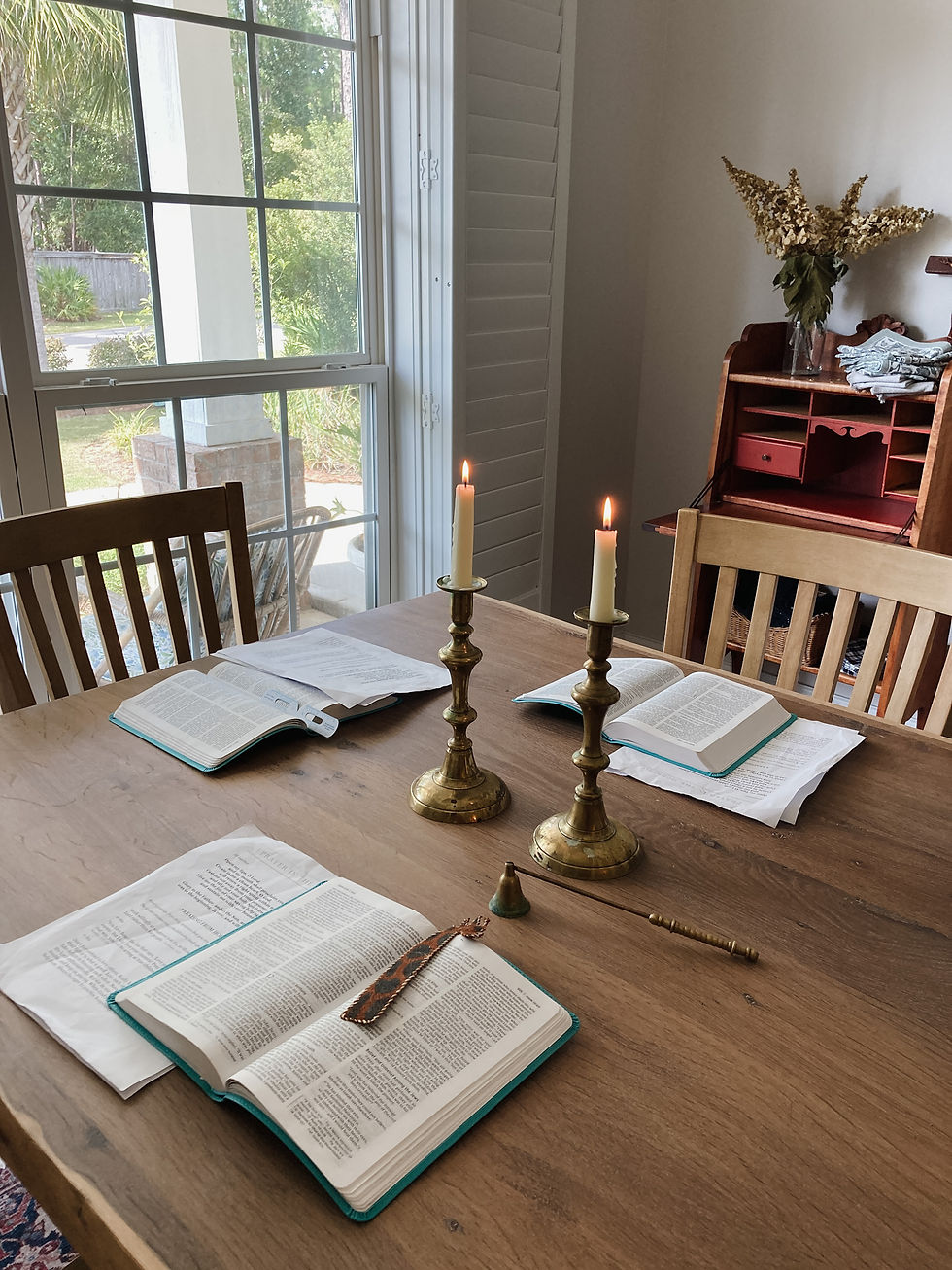
One of the simplest and most beautiful ways to mark the transition into prayer is to light a candle.
Throughout Christian history, candles have served as symbols of Christ, the Light of the World. But they also do something practical: they help us mark a moment as different from the rest of the day. In a home filled with noise, screens, and competing demands, the simple act of lighting a candle signals that something is about to happen that matters.
Children respond deeply to this kind of tangible practice. It creates a sense of anticipation. It draws their attention without a word being spoken.
If your children are old enough, give them roles. One child lights the candle. Another reads the Scripture passage. Another extinguishes the candle when you are finished, and if you want to make it memorable, purchase a candle snuffer and let them use it. These small rituals often become the moments children carry with them longest, precisely because they are invited to participate rather than simply observe.
(inexpensive taper candles, thrift store candlesticks or these wooden ones, kid-friendly candle lighter, candle snuffer)

Beginning a Rhythm of Prayer and Scripture
If the idea of daily prayer and Scripture reading feels overwhelming, start small.
One of the most common mistakes families make is trying to do too much too quickly. We imagine an ideal routine and then become discouraged when real life interrupts. But the Christians who shaped these practices across centuries were not living in monasteries. They were ordinary people with work and children and interruptions and tired evenings. The rhythms they developed were designed to survive real life, not ideal conditions.
Choose one moment in your day that already exists and attach your practice to it. Breakfast, the start of homeschooling, dinner, or bedtime, find what your family already does and let prayer grow from there, rather than trying to carve out entirely new space.
A simple rhythm might look like this:
Light a candle
Read a Psalm or a short passage of Scripture
Share prayer requests
Pray the Lord’s Prayer together
The entire practice can take five minutes. And five faithful minutes, day after day, will do more for your family than an elaborate routine practiced sporadically.
If you have young children, adapt freely. Let older children help read or lead. Give younger children something quiet for their hands while they listen. Keep your expectations realistic and remember that participation looks different at every age.
Where to Begin
You don’t need a special book or a formal program to begin. A Bible and a willingness to show up are enough. But if you find it helpful to have some structure as you start, here are a few accessible resources I created:
Most importantly, do not wait for the perfect season.
The great insight of Deuteronomy 6 is that faith formation does not require ideal circumstances. It requires only faithfulness in the ordinary moments, when you sit, when you walk, when you lie down, when you rise.
The Church across the centuries has shown us that this is enough. Your home provides the moments. What remains is simply to begin.
Light a candle. Open your Bible. Gather your family. That is enough.
This is the first in a series on creating a sacred home. Next: The Table: Shared Meals and Hospitality.


Comments